Deep Work vs Shallow Work: Why Most of Your Day is Wasted
Not all work is created equal. Understanding the difference between deep work and shallow work is the key to 10x productivity and career growth.
Deep Work vs Shallow Work: Why Most of Your Day is Wasted
If you're like most knowledge workers, you're busy all day but accomplish little that actually matters.
You respond to 50 emails. Attend 4 meetings. Check Slack 100 times. Update 3 spreadsheets. And at 5 PM, you realize: What did I actually create today?
The answer is often: nothing of real value.
The Two Types of Work
Cal Newport, in his book Deep Work, distinguishes between two fundamentally different types of work:
Deep Work
Cognitive demanding tasks requiring sustained focus
Examples:
- Writing a complex algorithm
- Designing a system architecture
- Writing an article or book chapter
- Solving a strategic business problem
- Learning a difficult new skill
Characteristics:
- Requires flow state (90-180 minutes of focus)
- Creates unique value (hard to replicate)
- Builds rare skills (increases your market value)
- Cannot be done while distracted
Shallow Work
Logistical, administrative tasks that don't require deep focus
Examples:
- Responding to most emails
- Scheduling meetings
- Updating task trackers
- Most Slack conversations
- Filing expense reports
Characteristics:
- Can be done while distracted
- Easy to replicate (anyone can do it)
- Doesn't build rare skills
- Feels productive but isn't
The Uncomfortable Truth
Most knowledge workers spend 80% of their time on shallow work and wonder why they're not advancing their careers.
Here's the math:
40 hours per week
- 10 hours in meetings
- 10 hours on email/Slack
- 5 hours on admin tasks
= 15 hours for actual work

Of those 15 hours:
- 10 hours fragmented (interrupted every 15-20 min)
- 5 hours potentially focused

REAL deep work per week: ~5 hours (12.5% of your time)
And we wonder why innovation is slow.
Why Shallow Work Feels Productive
Shallow work has a dangerous property: it feels like work.
Responding to emails gives you a dopamine hit. Checking off tasks feels good. Being "responsive" makes you feel valued.
But at the end of the year, shallow work produces:
- No new skills
- No unique output
- No career advancement
- No competitive advantage
Meanwhile, someone spending 20 hours/week in deep work:
- Builds rare, valuable skills
- Creates irreplaceable output
- Advances rapidly
- Becomes hard to compete with
The Deep Work Calculation
Want to see if you're actually being productive?
Track this for one week:
Hours in flow state (uninterrupted, focused work):  _____
Divided by total work hours:                        _____
= Your deep work percentage:                        _____%
Most people are shocked. They think they're at 60%. They're actually at 10-15%.
Why We Default to Shallow Work
Shallow work is easier. It:
- Requires no mental effort
- Provides immediate feedback
- Makes you feel busy
- Carries less risk
- Is more comfortable
Deep work is hard. It:
- Requires intense focus
- Has delayed feedback
- Is often uncomfortable
- Carries more risk (what if you fail?)
- Demands solitude
We naturally gravitate toward easy. But easy doesn't build careers.
How to Shift the Balance
You can't eliminate shallow work. But you can contain it.
1. Time-Box Shallow Work
Instead of: Responding to email throughout the day Try: Two 30-minute email blocks (morning and afternoon)
Instead of: Slack always open Try: Slack check-ins at 11am and 3pm
2. Protect Deep Work Blocks
Reserve your best hours (usually morning) for deep work:
- 8am-12pm: Deep work only (no meetings, no email)
- 1pm-5pm: Meetings, email, shallow work
3. Batch Shallow Tasks
Instead of: Updating task trackers as things happen Try: One 30-minute admin session at end of day
4. Measure What Matters
Track deep work hours, not busy work:
- Goal: 20 hours of deep work per week
- Not: "Respond to all emails within 1 hour"
The Career Impact
Two knowledge workers. Same job. Same company. Five years later:
Person A (shallow work focused):
- Responsive to all emails
- Attends all meetings
- Busy all day
- No rare skills developed
- Minimal career growth
Person B (deep work focused):
- Protects 20 hours/week for deep work
- Says no to most meetings
- Less "responsive" but 10x more productive
- Builds rare, valuable skills
- Rapid career advancement
Who would you rather be?
Start Tomorrow
Here's your action plan:
- Track your deep work hours this week (be honest)
- Block 2 hours tomorrow morning for ONE deep work task
- Turn off all notifications during that block
- See what you accomplish
Then gradually expand. Add more blocks. Protect more time. Build the habit.
The Bottom Line
Shallow work is infinite. You'll never be "done" with email. There will always be more Slack messages. Another meeting to attend.
But deep work—work that actually matters—is finite and valuable. It's what builds careers, creates breakthroughs, and produces work that lasts.
Stop optimizing for responsiveness. Start optimizing for depth.
Your career—and your sanity—will thank you.
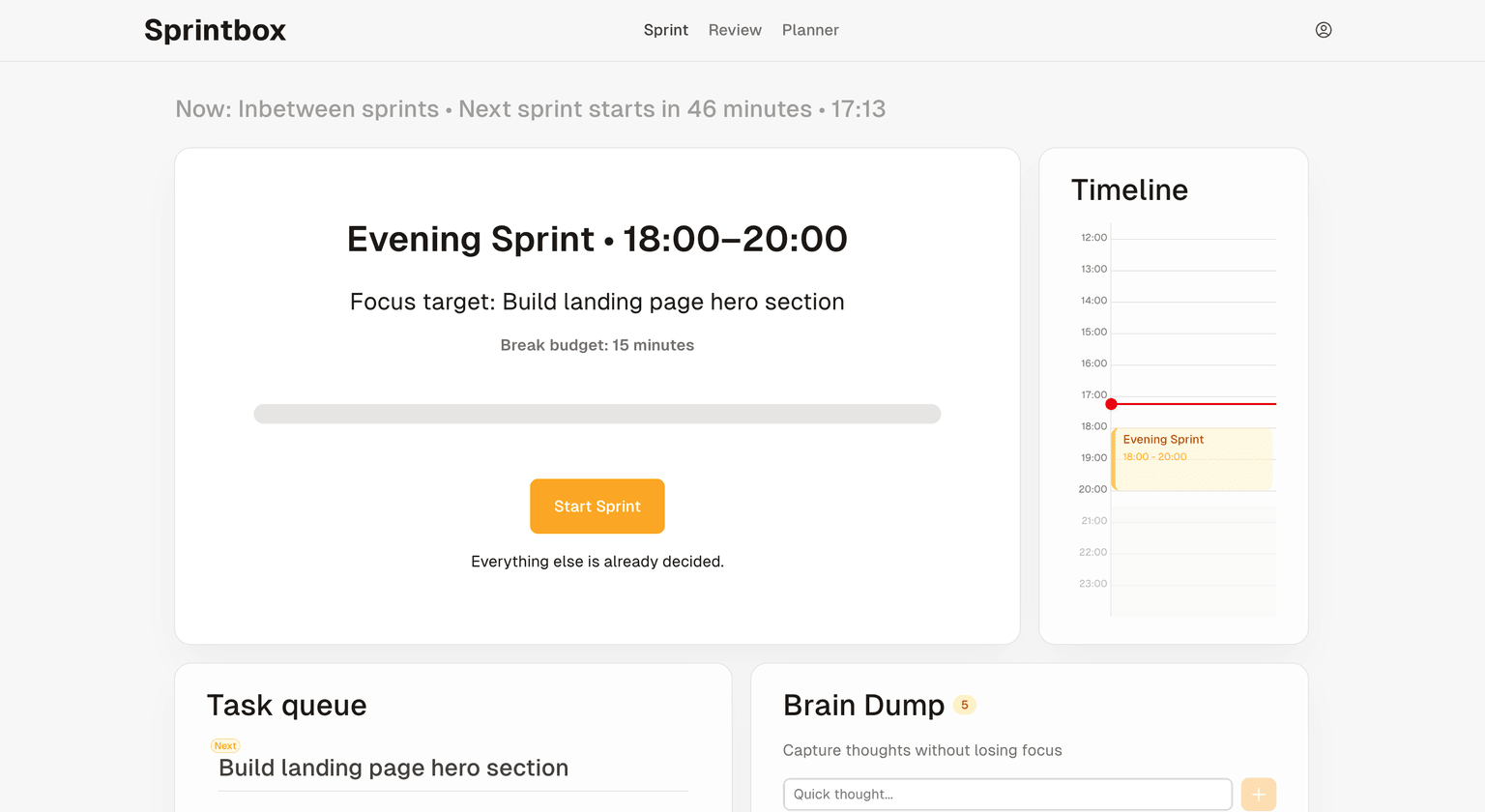
Need structure for deep work? Sprintbox helps you protect time, stay focused, and actually accomplish what matters. Try it free for 7 days.